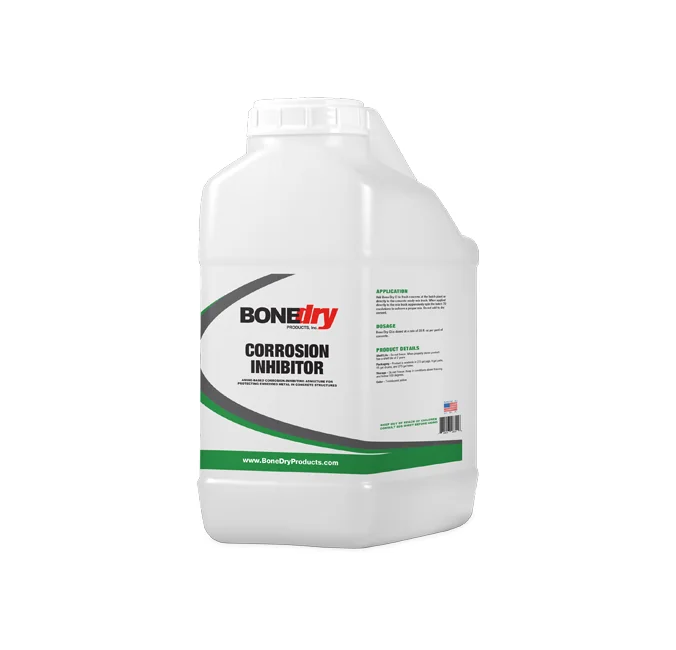
Bone Dry Corrosion Inhibitor
Price range: $95.00 through $13,750.00
Amine-based corrosion-inhibiting admixture for protecting embedded metal in concrete structures.
Coverage
- 28 fl. oz per yard of concrete
Product Info
- Protects rebar and other embedded metal from corrosion
- Extends the life of concrete structures
- Protects concrete near saltwater
- Works for precast & ready-mix concrete
Important Documents
Description
Stop corrosion before it starts. Bone Dry CI is a chloride-free, amine-based corrosion inhibiting admixture that shields embedded steel at both the anode and the cathode — so reinforcement stays passive for the life of the structure, not just its first winters. One flat dose. No change to your mix. ASTM C1582 compliant.
Tap to enlarge
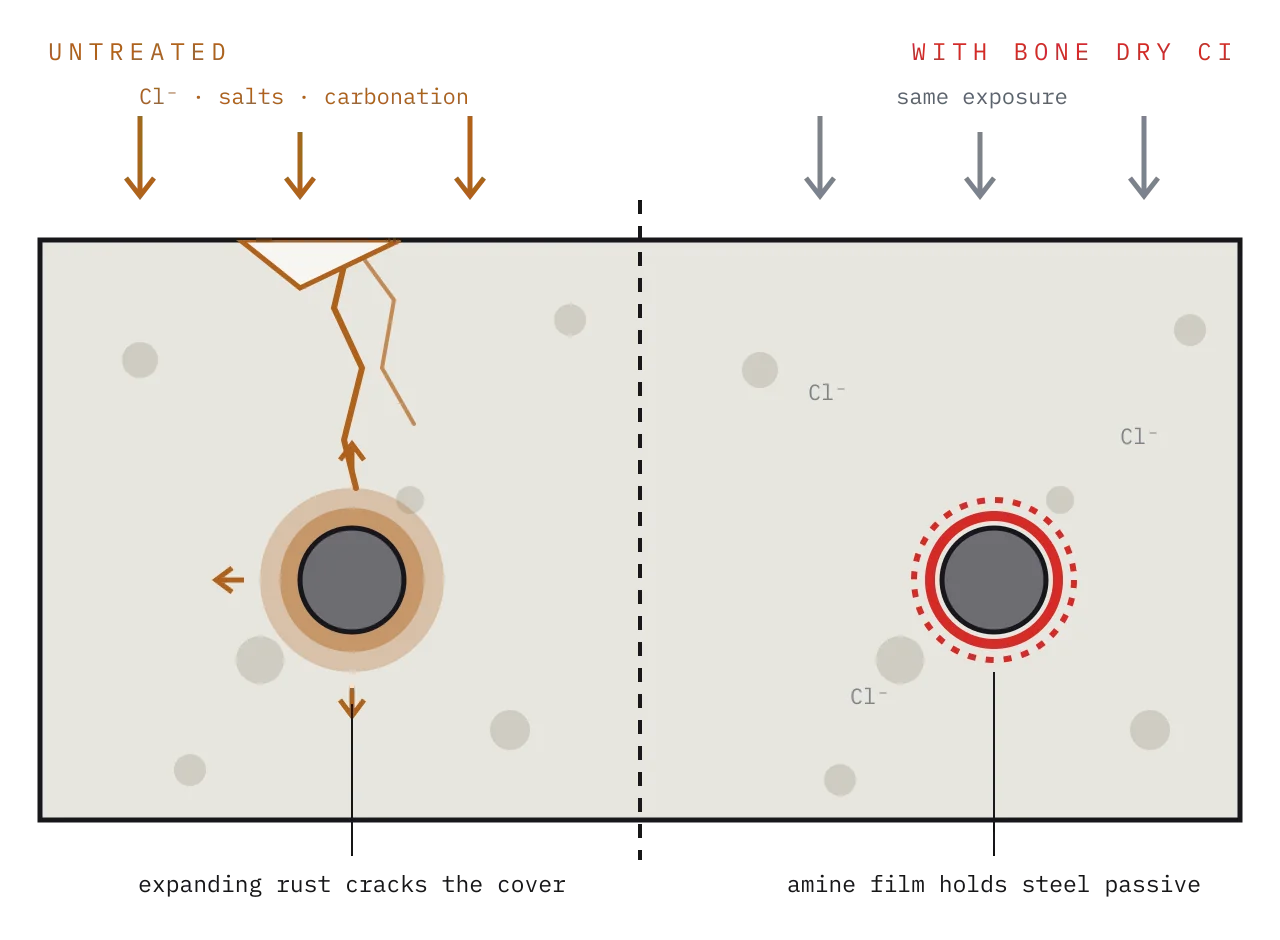
Untreated vs. treated: same exposure, different outcome
In untreated concrete, chlorides, salts, and carbonation reach the rebar; expanding rust then cracks the concrete cover. With Bone Dry CI in the mix, the same exposure meets an amine film that holds the steel passive.
Corrosion is a chain reaction
Each stage feeds the next — and once cracking starts, the cycle accelerates. The only economical place to stop it is before it starts.
Tap to enlarge
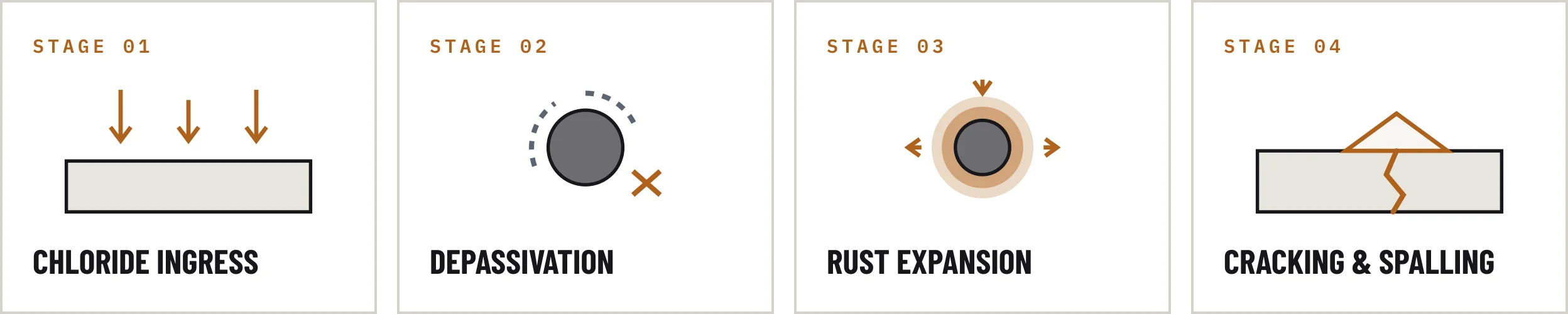
The four stages of rebar corrosion
Stage 1: chloride ingress through the concrete. Stage 2: depassivation — the protective oxide layer on the steel breaks down. Stage 3: rust expansion on the bar. Stage 4: cracking and spalling of the concrete cover. Bone Dry CI interrupts the cascade before it starts.
Dual-action defense, down at the bar
Tap to enlarge
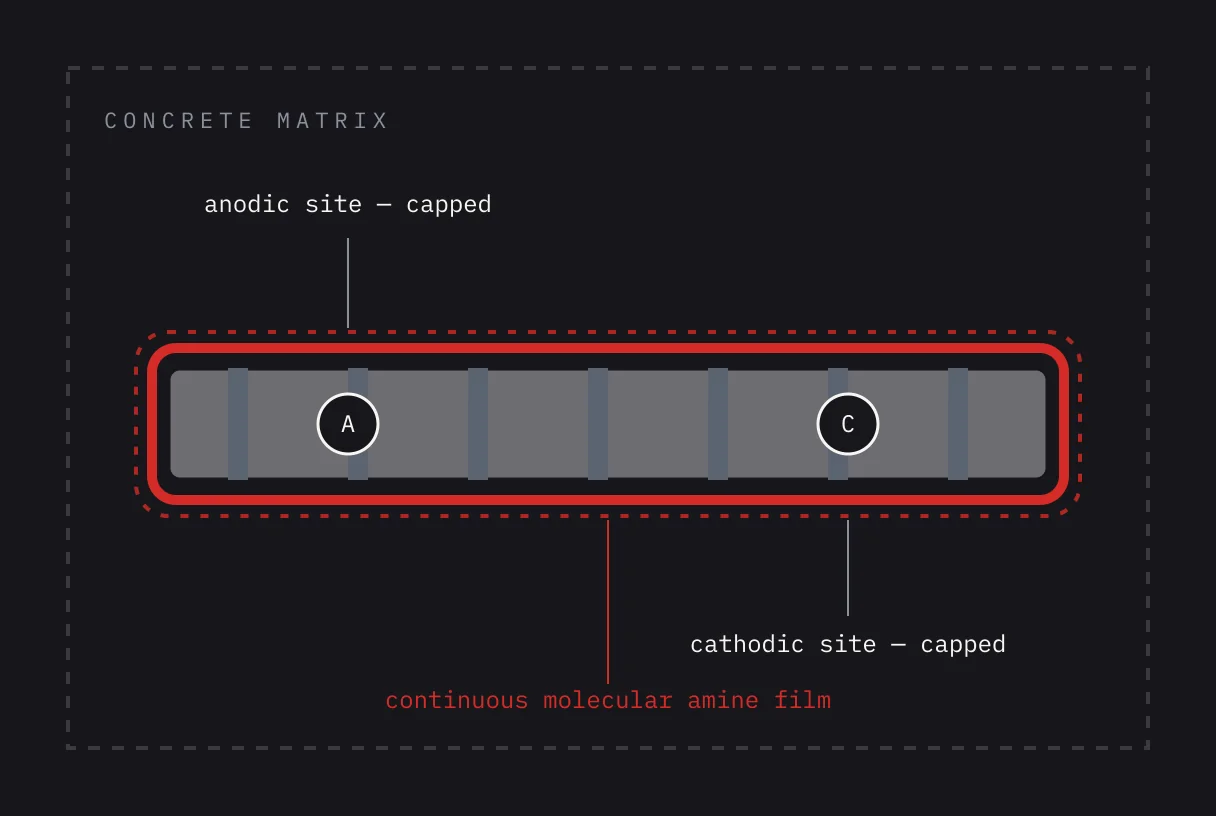
Dual-action mechanism: anodic and cathodic sites capped
Within the concrete matrix, Bone Dry CI forms a continuous molecular amine film along the reinforcing steel, capping both anodic and cathodic sites on the bar — the two halves of the corrosion cell.
Corrosion is an electrochemical cell with two halves. Most inhibitors interrupt one. Bone Dry CI’s amine chemistry adsorbs directly onto embedded metal and shuts down both — the anodic (iron-dissolution) side and the cathodic (oxygen-reduction) side — on ferrous and nonferrous metals alike: rebar, galvanized inserts, aluminum conduit.
Six properties tested. One changes.
| Property | Effect of Bone Dry CI |
|---|---|
| Slump | No change |
| Set time | No change |
| Air content | No change |
| Density | No change |
| Permeability | No change |
| Compressive strength | Increase up to 20% |
Versus typical calcium nitrite inhibitors
| Bone Dry CI | Typical CNI | |
|---|---|---|
| Dose per yd³ | 28 fl oz, flat | 2–6 gal, tiered to chloride exposure |
| Set time | No change | Accelerates; retarder often required |
| Plastic properties | Unchanged | Mix adjustments may be needed |
| Strength effect | Up to +20% | No gain claimed |
| Protection mode | Anodic + cathodic | Primarily anodic |
CNI column reflects typical published manufacturer literature for 30% calcium nitrite admixtures. Verify against project-specific data.
Where to use it
Specified for all steel-reinforced concrete — anywhere steel meets salt:
- Coastal and marine structures, piers, and docks
- Parking garages and ramps
- Highways and bridges
- Pools and treated-water surrounds
- Concrete buildings, columns, poles, and barriers
Dosing is the easy part
Tap to enlarge
Field steps
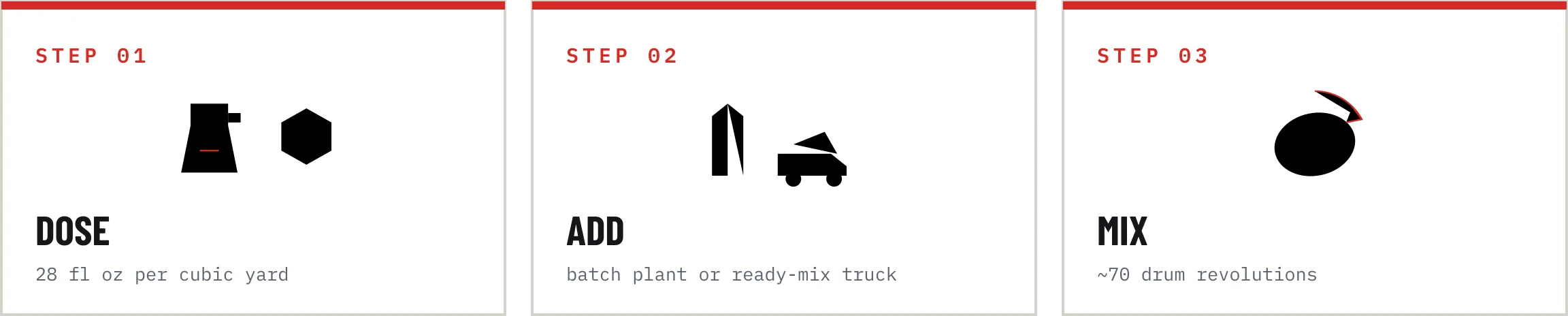
- Dose — 28 fl oz per cubic yard.
- Add — at the batch plant or into the ready-mix truck.
- Mix — about 70 drum revolutions.
Note: add to fresh concrete only — never to dry cement — and do not allow the product to freeze in storage.
Packaging & coverage

Tap to enlarge
Packaging
Available in 2.5-gallon jugs, 5-gallon pails, 55-gallon drums, and 275-gallon totes.
| Container | Size | Treats approx.* |
|---|---|---|
| Jug | 2.5 gal | ~11 yd³ |
| Pail | 5 gal | ~22 yd³ |
| Drum | 55 gal | ~250 yd³ |
| Tote | 275 gal | ~1,250 yd³ |
*At the standard dose of 28 fl oz per cubic yard.
Technical data
| Specific gravity | 1.24 (1.20–1.30) |
| pH | 9.5 (9.0–10.0) |
| Activity | 67% (60–70%) |
| Unit weight | 10.34 lb/gal |
| Chloride content | 0% |
| Freezing point | 32°F / 0°C |
| Color | Translucent yellow |
| Shelf life | 2 years, stored above 32°F and below 100°F |
| Specification | ASTM C1582 |
Put Bone Dry CI in the spec. Dosage guidance, submittal documents, and mix-trial support — direct from the people who formulate it. Call 262-694-9748 or email [email protected].
FAQ
What is Bone Dry Corrosion Inhibitor?
A chloride-free, amine-based corrosion-inhibiting admixture for reinforced concrete. Dosed at the batch plant, it protects the embedded steel from the day the pour goes in.
What is the dose rate?
28 fluid ounces per cubic yard, regardless of chloride exposure, added at the batch plant or into the ready-mix truck with about 70 drum revolutions. Add to fresh concrete only, never to dry cement, and do not let it freeze in storage.
Does it change the concrete mix?
No. Slump, set time, air content, density, and permeability are unchanged, and compressive strength increases by up to 20%.
Is it ASTM compliant?
Yes. Bone Dry Corrosion Inhibitor is ASTM C1582 compliant.
How does it compare to calcium nitrite inhibitors?
It is chloride-free and does not accelerate set the way calcium nitrite inhibitors typically do, so no retarder is needed, and the dose is a flat 28 fluid ounces per cubic yard rather than scaling with exposure.
Where should it be specified?
Anywhere steel meets salt: parking structures, bridges, coastal and marine work, pools, and any reinforced concrete exposed to deicing salt or salt air.
How much do I need?
At the standard dose, a 2.5-gallon jug treats about 11 cubic yards, a 5-gallon pail about 22, a 55-gallon drum about 250, and a 275-gallon tote about 1,250.
Can it be used with Bone Dry Pro Admix in the same pour?
Yes. Dose the two admixes separately.
Specifications
Read more about the specifications here.
Additional information
| Weight | N/A |
|---|---|
| Dimensions | N/A |
| Size | 1 Gallon, 2.5 Gallon, 5 Gallon, 55 Gallon, 275 Gallon |