Bone Dry Corrosion Stop
Price range: $85.00 through $7,925.00
Amine-based corrosion-inhibiting spray for protecting embedded metal in concrete structures.
Coverage
- 100 sqft per gallon
Product Info
- Penetrates existing concrete without any profiling
- Extends the service life of reinforced concrete structures
- Does not change the characteristics or porosity of the existing concrete
- Water base for easy handling
- Does not contain any hazardous calcium nitrite products
- Easily applied using a sprayer
Important Documents
Description
The steel in your structure is already on the clock. Every winter of deicing salt, every season of salt air, pushes chlorides deeper into the cover toward the rebar. Bone Dry Corrosion Stop is an amine-based, migrating corrosion inhibitor for structures that are already standing: spray it on the surface, and it travels through the concrete to the steel — forming a protective film on the bar before corrosion ever initiates.
Tap to enlarge
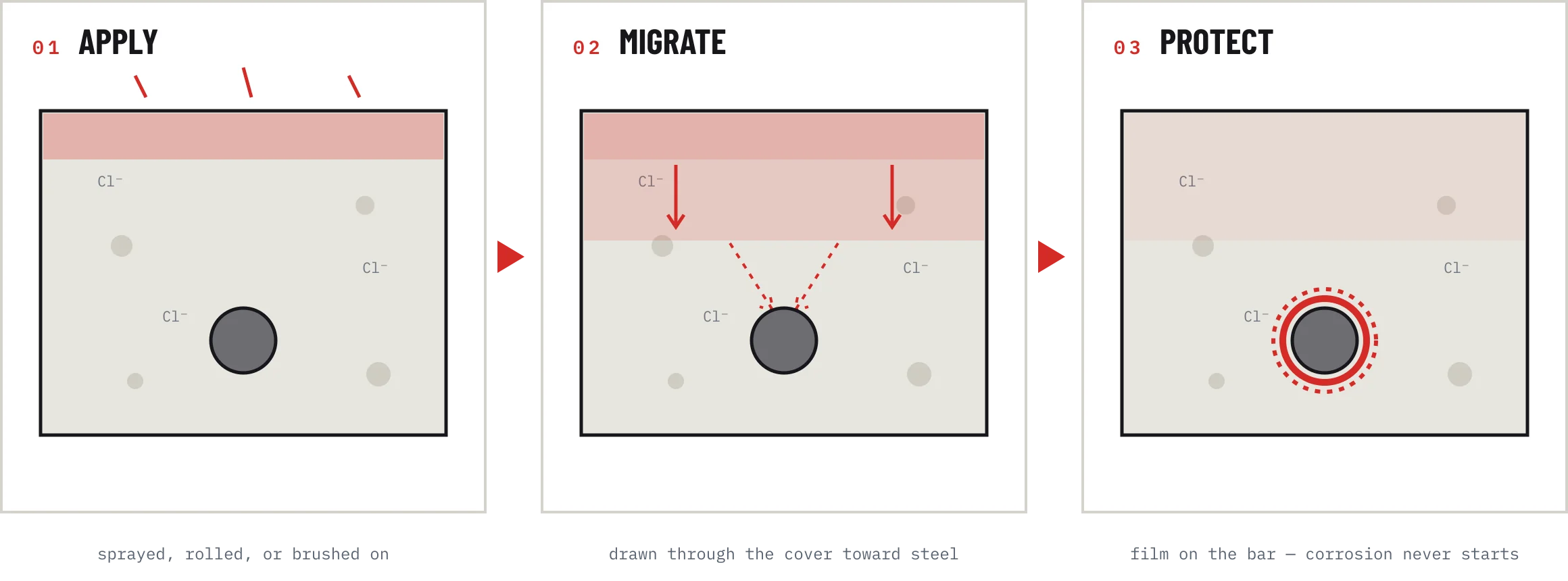
Apply, migrate, protect
Corrosion Stop is sprayed, rolled, or brushed onto the concrete surface; it is drawn through the concrete cover toward the steel; and it forms a film on the bar so corrosion never starts.
It travels to the steel
Corrosion Stop is attracted to metal. Sprayed, rolled, or brushed onto any horizontal or vertical surface of a steel-reinforced structure, it absorbs into the concrete and migrates to the embedded reinforcement, coating ferrous and nonferrous metals alike. The film it forms shuts down both halves of the corrosion cell — anodic and cathodic — so chloride ingress can’t start the rusting process. It’s clear, nitrite-free, VOC-free, and completely non-destructive: the concrete’s existing characteristics don’t change at all.
What it does for the structure
| Function | What it means for the asset |
|---|---|
| MIGRATES | Applied at the surface, drawn through the cover — reaches steel you can’t |
| SHIELDS | Anodic and cathodic protection on ferrous and nonferrous metals |
| PRESERVES | Prevents chloride-driven rusting — extends the structure’s service life |
| DISAPPEARS | Dries clear; the concrete’s appearance and characteristics are unchanged |
| CLEAN CHEMISTRY | Nitrite-free and VOC-free |
The cheapest year to treat a structure is this one
Tap to enlarge
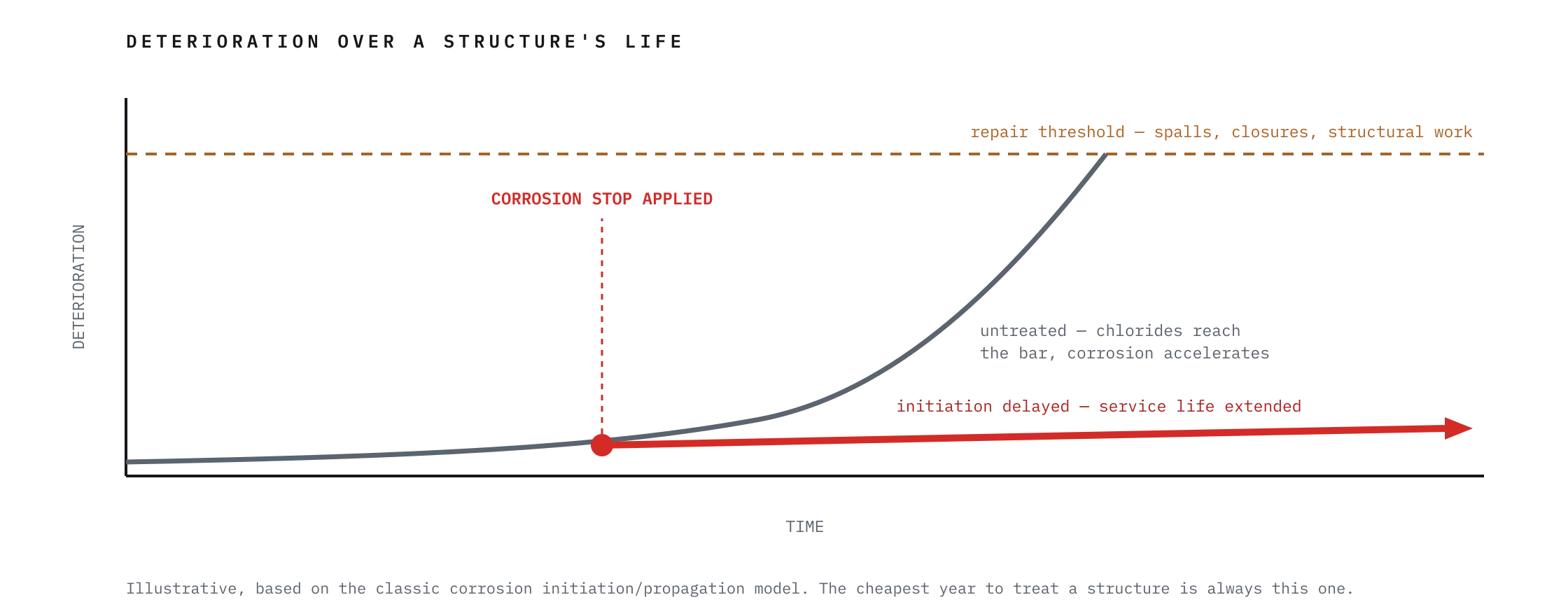
Deterioration over a structure’s life
Untreated, chlorides eventually reach the bar and corrosion accelerates toward the repair threshold — spalls, closures, structural work. Applying Corrosion Stop delays initiation and extends service life. (Illustrative, based on the classic corrosion initiation/propagation model. The cheapest year to treat a structure is always this one.)
Reinforced concrete fails on a curve: a long, quiet initiation phase while chlorides work inward, then a knee, then the expensive part — spalls, closures, structural repairs. Corrosion Stop is preventative maintenance for the quiet phase. Treat the structure while intervention is still a spray rig and a weekend, and the knee moves years down the road.
| Treat now — Corrosion Stop | Repair later | |
|---|---|---|
| Timing | Before damage shows | After spalls appear |
| Disruption | Spray-applied, non-destructive | Demolition, patching, closures |
| Coverage | The whole element — every bar | Only the spots that already failed |
| Cost profile | A maintenance-budget line item | Escalating repair cycles |
Corrosion Stop is preventative maintenance. Elements with advanced deterioration still require engineered concrete repair.
Every face of the structure
Tap to enlarge
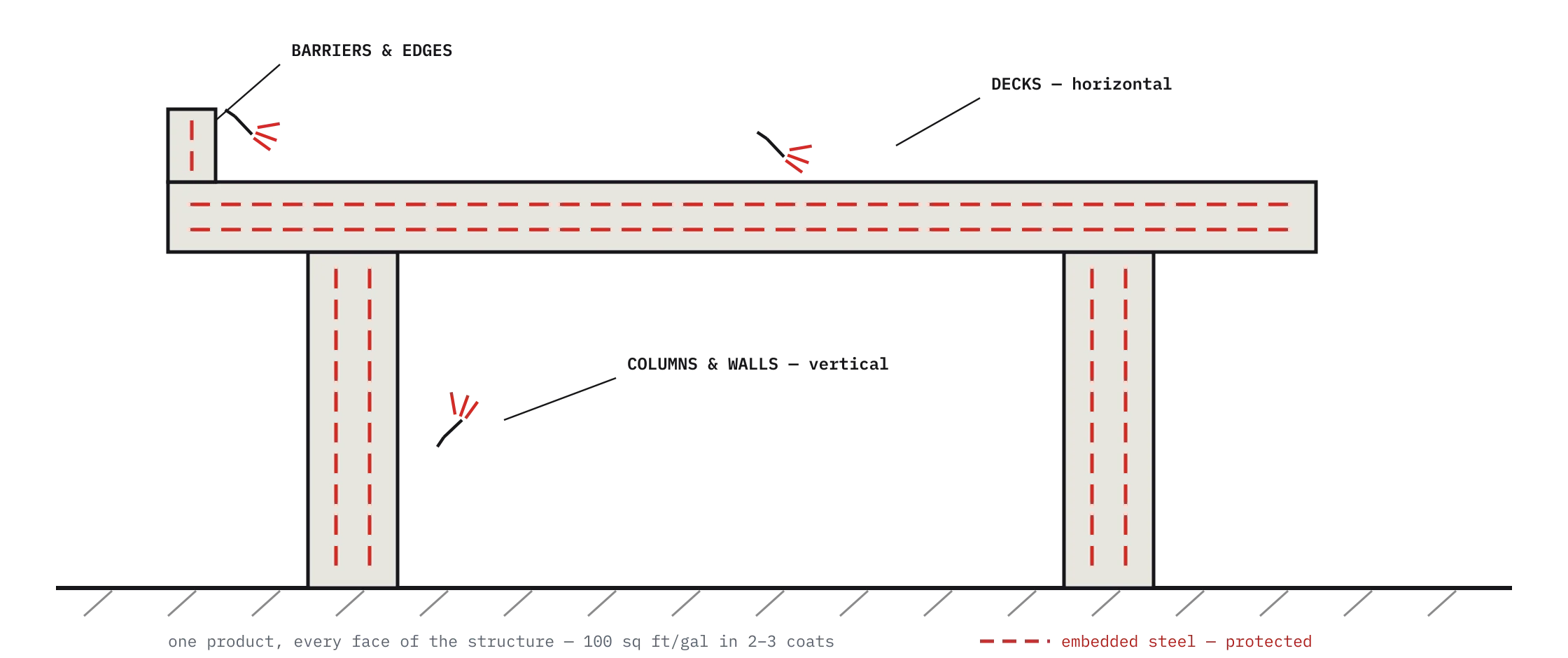
One product for every face of the structure
Barriers and edges, horizontal decks, vertical columns and walls — one product treats every face of the structure at 100 sq ft per gallon in 2–3 coats, protecting the embedded steel throughout.
Decks take it horizontally, columns and walls take it vertically — Corrosion Stop applies to any existing surface of a steel-reinforced structure. Parking garages, bridges and highway structures, Jersey and marine barriers, building exteriors, and cast-in-place, precast and post-tensioned concrete: if there’s steel behind the surface, the same spray protects it.
Which corrosion product does your project need?
| Project condition | Use |
|---|---|
| Structure already standing | Corrosion Stop — 2–3 surface coats, migrates to the steel |
| Concrete not poured yet | Bone Dry CI Admixture — 28 fl oz/yd³ at the batch plant |
Application
Tap to enlarge
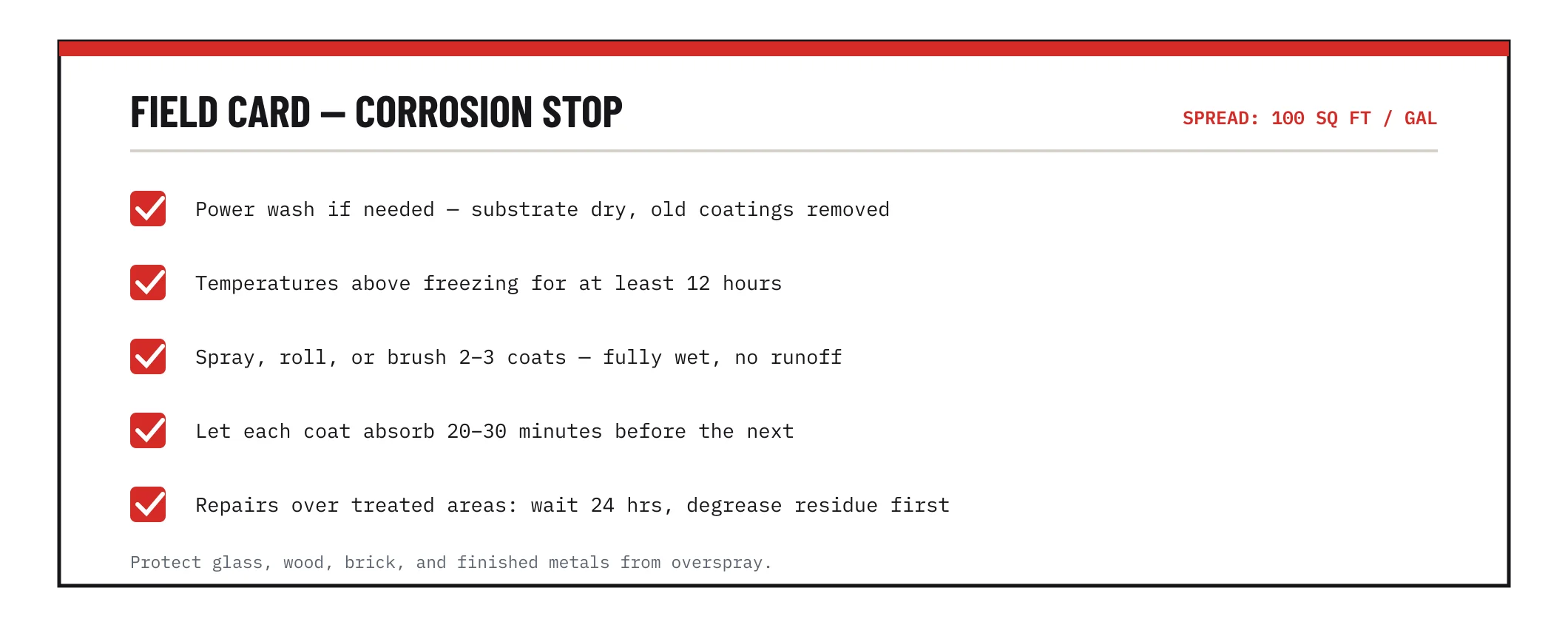
Field card: application checklist
- Power wash if needed — substrate dry, old coatings removed.
- Concrete above freezing at application, and kept above freezing for 12 hours after application.
- Spray, roll, or brush 2–3 coats or more, until the total spread reaches 100 sq ft per gallon.
- Let each coat absorb 20–30 minutes before the next.
- Repairs over treated areas: wait 24 hours and degrease residue first.
Spread rate: 100 sq ft per gallon. Protect finishes including finished metals, wood, and brick to avoid discoloration.
Good to know: apply with an airless, battery-powered, or pump sprayer — or brush and roll where that’s easier. If concrete repairs are planned over treated areas, let the inhibitor absorb for 24 hours, then remove any surface residue with Bone Dry Concrete Degreaser before patching (auto-scrub or pressure wash horizontal surfaces; rinse verticals).
Technical data
| Chemistry | Amine-based migrating corrosion inhibitor |
| Protection | Anodic + cathodic; ferrous and nonferrous metals |
| Nitrite / VOC | Nitrite-free · VOC-free |
| Appearance | Clear — concrete characteristics unchanged |
| Application | Spray, roll, or brush — horizontal and vertical surfaces |
| Coats | 2–3 or more, until the total spread reaches 100 sq ft per gallon; allow each coat to absorb 20–30 minutes between applications |
| Coverage | 100 sq ft per gallon, total spread |
| Temperature | Concrete above freezing at application; keep above freezing for 12 hours after application |
| Repairs over treated areas | Allow 24-hr absorption; degrease residue before patching |
Protect the structure while it’s still cheap to protect. Send us the element list and square footage — decks, columns, walls — and we’ll size the order. Call 262-694-9748 or email info@bonedryproducts.com.
FAQ
What is Bone Dry Corrosion Stop and where is it used?
A surface-applied, migrating corrosion inhibitor for existing reinforced concrete structures exposed to deicing salt or salt air: parking garages, bridges and highway structures, Jersey and marine barriers, building exteriors, and cast-in-place, precast and post-tensioned concrete. It is preventative maintenance for the whole element.
How does it reach the rebar?
Sprayed, rolled, or brushed onto the concrete, it migrates through the cover to the embedded steel and forms a protective film on the bar that shuts down both the anodic and cathodic halves of the corrosion cell before chloride ingress can start rusting.
How many coats, and what coverage?
Two to three coats or more, until the total spread reaches 100 square feet per gallon, letting each coat absorb for 20 to 30 minutes before the next. An airless, battery-powered, or pump sprayer all work, with a brush or roller where needed, on decks horizontally and on columns and walls vertically.
Can Corrosion Stop be applied in cold weather?
The concrete must be above freezing at application and stay above freezing for 12 hours after application. The substrate must be dry, clean, and free of surface coatings, dirt, and debris; power wash first if needed.
Can it fix concrete that is already spalling?
No. Elements with advanced deterioration need engineered concrete repair first; Corrosion Stop then protects the rest of the element from following.
Can I patch or repair over treated areas?
Yes. Allow 24 hours of absorption, then remove the surface residue with Bone Dry Concrete Degreaser before patching.
What is the difference between Corrosion Stop and Corrosion Inhibitor?
Timing. Corrosion Stop is applied to the surface of a structure that is already standing. Corrosion Inhibitor is an admixture dosed into concrete that has not been poured yet, at 28 fluid ounces per cubic yard.
If I use Corrosion Stop and Structural Sealer on the same element, which goes first?
Corrosion Stop first, all two to three coats fully absorbed, then Structural Sealer.
Additional information
| Weight | N/A |
|---|---|
| Dimensions | N/A |
| Size | 1 Gallon, 5 Gallon, 55 Gallon, 275 Gallon |