
Bone Dry Block Wall
Price range: $150.00 through $495.00
For use on CMU block walls to seal and waterproof, protecting interior structures and interior CMU Coatings
Product Info
- Use on CMU blocks prior to Bone Dry Sealers
- Allows Bone Dry to react with concrete
- Use with either our Original or Plus Sealer
Important Documents
Description
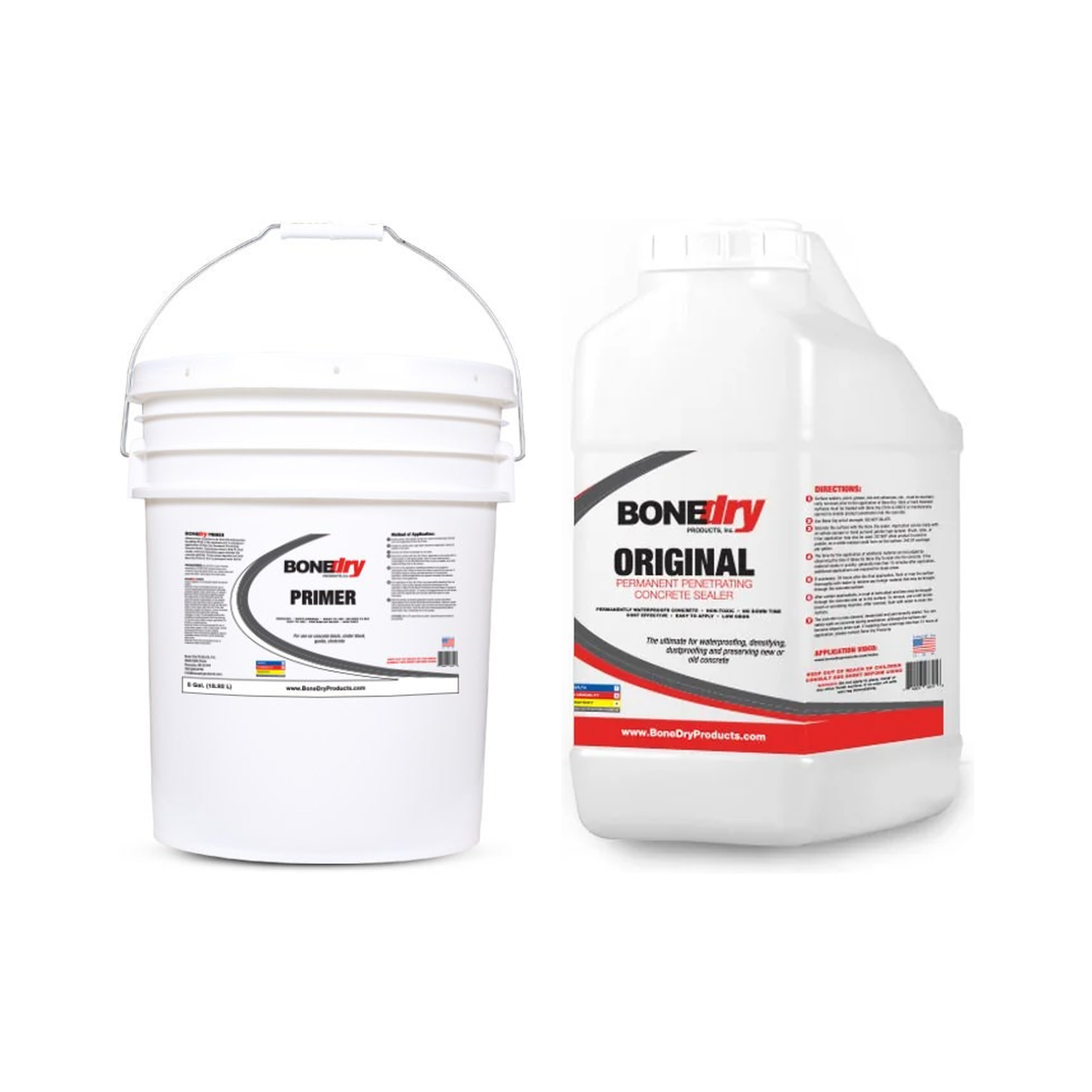
Block walls weep because they’re built to. CMU is an affordable material precisely because it uses less cement — which leaves wide interstitial gaps that drink groundwater and hand it to your basement. Sealers alone can’t fix it: Bone Dry sealers work by reacting with alkali, and pervious block doesn’t carry enough to feed the reaction. The Bone Dry Block Wall system solves it in two steps — Block Wall supplies the alkali, and Original or Plus reacts with it to form a permanent moisture seal inside the block itself.

Tap to enlarge
Below-grade block wall in section: where the barrier forms
Soil and hydrostatic water press against the hollow cores of a below-grade CMU wall. Bone Dry Block Wall is applied from the inside and penetrates deep into the block; in the Block Wall + sealer zone, alkali is deposited, reacted, and sealed — the barrier forms inside the block, before water ever reaches the room, keeping the finished basement dry.
Chemistry that needs a partner
Bone Dry Block Wall is a colorless, non-toxic, water-based blend of inorganic suspended solids. Sprayed on the interior face, it penetrates deep into the block, filling hairline cracks, small voids, and the interstitial spaces between matrix particles — and depositing the alkali the sealer needs. Then Bone Dry Original or Plus goes on while Block Wall is still damp, reacts with those deposits, and fills every small space in the substrate to form a permanent water barrier. The wall stays a wall; the barrier lives inside it.
The system
| Step | What it does |
|---|---|
| 1 — Bone Dry Block Wall | Penetrates deep; fills gaps, cracks, and voids; deposits the alkali the sealer needs |
| 2 — Original or Plus Sealer | Reacts with the Block Wall deposits — permanent moisture seal in the block. Choose Plus for antimicrobial protection in mold-prone basements. |
Why block needs Block Wall

Tap to enlarge
Free alkali: what the sealer reacts with
Bone Dry sealers react with free alkali in the substrate. Poured concrete carries enough for the sealer to react fully; a pervious CMU block wall runs short and can’t fully react on its own. Block treated with Block Wall tops up the alkali for a permanent seal. (Qualitative.)
| Poured concrete | CMU block wall | |
|---|---|---|
| Free alkali | Plenty — sealer reacts fully | Runs short — needs Block Wall |
| Porosity | Fine capillaries | Wide interstitial gaps |
| Sealer alone | Works as designed | Not enough — always prime first |
| The system | Sealer | Block Wall + sealer |
Which surfaces need Block Wall?

Tap to enlarge
The pervious three: always prime first
Concrete block, shotcrete, and gunite are extremely porous — always prime before sealing.
| Your surface | Use |
|---|---|
| CMU block wall, Shotcrete, Gunite, or extremely porous concrete | Bone Dry Block Wall + Original or Plus |
| Standard poured concrete slab or wall | Original, Plus, or Pro — no primer needed |
| Painted block (latex, acrylic, polyvinyl) | Strip the paint first — Block Wall can’t penetrate it |
Application

Tap to enlarge
Application: built like a wall, bottom up
- Prep & mist — unpainted and clean; dampen with a fine water mist.
- Prime — saturate at 80–150 SF per gallon depending on porosity; if it soaks in within about 15 minutes, apply more.
- Seal while damp — apply Original or Plus once Block Wall reaches damp.
Result: waterproof — a permanent barrier deep in the block.
Good to know: dampen the wall first with a fine water mist — damp, not saturated — then saturate with Block Wall from a hand-pumped garden sprayer (airless spray for large areas) at roughly 80–150 square feet per gallon depending on porosity; if it soaks in within about fifteen minutes, apply additional material. Don’t let it pond or puddle on horizontal surfaces — move excess to high spots with a squeegee, mop, or broom. Use it at full strength only. Time the sealer to Block Wall: apply Original or Plus when Block Wall reaches a damp condition. If over-application leaves white deposits, brush or flush them off with water before the next Bone Dry coat — accidental over-application won’t discolor the wall. Keep the surface above 45°F, and shield vegetation and adjacent finishes from overspray outdoors.
Technical data — Bone Dry Block Wall
| Appearance | Colorless — will not discolor the surface |
| Chemistry | Water-based inorganic suspended solids; no organics, no heavy metals |
| Safety | Non-toxic; non-flammable; no harmful fumes; negligible odor |
| pH / solids / SG | pH 9.0 · 5.1% total solids · specific gravity 1.045 |
| Coverage | ~80–150 sq ft per gallon, by substrate porosity |
| Application | Saturate at full strength — hand-pumped garden sprayer (airless spray for large areas); add material wherever it soaks in within about 15 minutes |
| Sealer timing | Apply Original or Plus while Block Wall is damp |
| Dilution | None — full strength only |
| Minimum temperature | 45°F surface; do not store or apply frozen |
| Substrates | Cement-based materials only — does not effectively penetrate asphalt, metal, wood, brick, or masonry; not over latex-binder mortar or grout |
Damp block basement? Weeping foundation wall? Send us the wall square footage and we’ll size Block Wall and the sealer together as one system. Call 262-694-9748 or email info@bonedryproducts.com.
FAQ
When should Bone Dry Block Wall be used?
Always use Block Wall on CMU walls, shotcrete, and gunite.
Can Bone Dry Block Wall be used on its own?
No. Bone Dry Block Wall is the primer: it adds the alkali the sealer needs. Apply Bone Dry Original or Plus once Block Wall has dried to a damp condition to form the water barrier; Block Wall is sold bundled with either sealer.
How do I seal high-porosity concrete?
Our concrete moisture mitigation system delivers superior protection from dampness hidden deep within concrete slabs and subfloors. Pervious concrete materials like Shotcrete, Gunite or cement block walls demand our specialized Bone Dry Block Wall.
Why won't a regular sealer or waterproof paint fix my weeping block wall?
Block is pervious by design: it uses less cement than poured concrete, which leaves wide interstitial gaps that drink groundwater, and it does not carry enough free alkali for a penetrating sealer to react with. Paints sit on the surface and lift as water pushes from behind. The Block Wall system supplies the missing alkali with Block Wall, then seals inside the block with Original or Plus.
How much Bone Dry Block Wall do I need?
Saturate the wall with Block Wall at roughly 80 to 150 square feet per gallon depending on porosity, applied at full strength with a low-pressure garden sprayer (airless spray for large areas). If it soaks in within about fifteen minutes, apply additional material. Send us the wall square footage and we will size Block Wall and the sealer as one system.
Do I have to dig outside to waterproof a block foundation wall?
No. The Block Wall system is applied from the inside face of the wall. Block Wall penetrates deep into the block, and the sealer, applied while Block Wall is still damp, forms the barrier inside the block before water reaches the room.
Can I apply Bone Dry Block Wall over painted block?
No. Bone Dry Block Wall will not penetrate latex, polyvinyl, acrylic, or nonporous rubber-based paints. Strip the paint first so Block Wall can reach the block.
White deposits appeared after priming. Is something wrong?
That is over-application: Block Wall left excess solids on the surface. Brush them off or flush with water before the next coat or the sealer goes on. It will not discolor the wall.
Additional information
| Weight | N/A |
|---|---|
| Dimensions | N/A |
| Size | 1 Gallon with Original, 5 Gallon with Original, 1 Gallon with Plus, 5 Gallon with Plus |