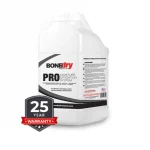
Gypsum underlayment — gypcrete poured over a plywood subfloor — is multifamily’s favorite floor: fire ratings, sound ratings, and a dead-flat surface. It is also the schedule’s favorite hostage. Gypsum is intensely moisture-sensitive, it dusts, and flooring cannot go down until the relative-humidity numbers cooperate. Penetrating concrete sealers are the wrong chemistry for it; Bone Dry’s own Pro sealer spec prohibits gypsum-based underlayments outright. Bone Dry Pro Gyp-Cap is the purpose-built answer: a single-component, solvent-free, membrane-forming coating engineered for gypsum that caps moisture at up to 100% relative humidity, locks down dusting, and puts trades back on the floor in as little as 60 minutes — with no primer needed before flooring adhesives.
How do you mitigate moisture on gypsum underlayment before flooring?
Why gypsum is not concrete
A Bone Dry penetrating sealer works by reacting with the free lime and alkali in concrete. Gypsum has different chemistry, so the reaction never happens — which is why penetrating concrete sealers should never go on a gypsum pour. The second problem is dust. Every flooring installer knows the pull: press tape to raw gypsum underlayment and it comes up wearing the floor. That powder is exactly what the adhesive would have bonded to. On a Gyp-Capped surface the tape comes back clean, because the membrane has locked the surface down and the adhesive bonds to the membrane itself.
In the floor assembly, the Gyp-Cap membrane sits directly on the gypsum underlayment — above the plywood subfloor and joists, beneath the finished flooring. Moisture in the gypsum, up to 100% RH, is capped at the membrane, making the layer every unit stands on floorable.
What Gyp-Cap does for the floor
| Function | What it means on site |
|---|---|
| Caps | Moisture mitigation up to 100% relative humidity on gypsum substrates |
| Dustproofs | Locks down gypsum dusting so adhesives bond to the floor, not the powder |
| Speeds | Foot traffic in as little as 60 minutes — trades keep moving |
| Simplifies | No profiling and no primer before underlayment or flooring adhesives; the container reseals between units |
| Clean | Solvent-free, single-component, ready to use — no mixing, no ratios |
Gyp-Cap versus conventional gypsum prep
| Gyp-Cap | Conventional gypsum prep | |
|---|---|---|
| RH tolerance | Up to 100% RH | Flooring gated by RH limits and dry-down |
| Primer before adhesives | None needed | Typically required |
| Dust control | Membrane locks the surface | Separate sealer, or the dust persists |
| Trades back on | About 60 minutes | Gated by product dry times |
| Components | One — ready to use, resealable | Primer and sealer combinations |
The conventional column reflects typical published requirements of gypsum underlayment and flooring manufacturers. Verify against project-specific data.
Which product for which substrate
| Substrate | Use |
|---|---|
| Gypsum underlayment (gypcrete over plywood) | Bone Dry Pro Gyp-Cap |
| Bare concrete, new or existing | Bone Dry Pro penetrating sealer |
| Chemically abated black-mastic slab | Bone Dry Pro Encapsulator |
Mixed-substrate buildings are the normal case in multifamily: a concrete slab on grade at the ground floor and gypsum on the floors above. Run the concrete areas with Bone Dry Pro and the gypsum areas with Gyp-Cap. For the ground-floor slab, see Sealing a Slab on Grade Before Flooring; for the whole line, see the Bone Dry product selector.
How to apply Gyp-Cap
- Prep. Let the gypcrete cure a minimum of 5–7 days, then broom-sweep or vacuum it clean — anything left on the surface is trapped under the membrane. The surface must be smooth, porous, sound and clean, with the dew point at least 5 °F away from the substrate temperature. No profiling, no primer.
- Apply. One ready-to-use coat by spray or roller. One component out of one container — no mixing, no ratios — and the container reseals between units, which matters when you are coating a building one floor at a time.
- Walk and floor. Foot traffic in about 60 minutes; underlayment and flooring adhesives go on with no primer.
On a multifamily schedule every closed floor is a stacked delay — drywallers, painters, and trim carpenters all queue behind it. Sixty minutes to a working floor is the point.
Where this applies: Gypsum underlayment shows up on multifamily and mixed-use jobs; see concrete sealers for general contractors and concrete sealer specs for architects and specifiers. See all the industries we serve.
No. Penetrating concrete sealers work by reacting with the free lime and alkali in concrete, and gypsum does not have that chemistry — the Bone Dry Pro spec prohibits gypsum-based underlayments outright. Use Bone Dry Pro Gyp-Cap, a membrane-forming coating built specifically for gypsum.
Up to 100% relative humidity on gypsum-based substrates. The membrane caps the moisture at the surface, so flooring is no longer gated by RH limits and dry-down.
No. Gyp-Cap requires no profiling and no primer before underlayment or flooring adhesives — the adhesive bonds to the membrane.
As little as 60 minutes after application. Apply by spray or roller, one coat, and the floor takes foot traffic in about an hour.
Yes. The membrane locks down the surface, so tape pressed to a Gyp-Capped floor comes back clean instead of coated in powder, and flooring adhesive bonds to the membrane rather than to loose dust.
Two products, one system: Bone Dry Pro on the concrete areas and Gyp-Cap on the gypsum areas. Send us the floor count and square footage of each and we will size the order per building.
One part. It is a single-component, solvent-free, ready-to-use coating with no mixing or ratios, and the container reseals between units.