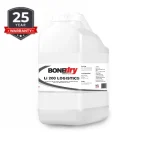
Block walls weep because they are built to. CMU is affordable precisely because it uses less cement, which leaves wide interstitial gaps and hollow cores that drink groundwater and hand it to your basement. A sealer or waterproof paint on its own will not fix it — Bone Dry sealers work by reacting with the alkali in a substrate, and pervious block does not carry enough to feed the reaction. The Bone Dry Block Wall system solves it in two steps from the inside of the wall: Bone Dry Block Wall penetrates deep into the block, fills the voids, and deposits the alkali the sealer needs; then Bone Dry Original or Bone Dry Plus goes on while Block Wall is still damp and reacts with those deposits to form a permanent moisture barrier inside the block itself. No excavation, no membrane, nothing on the surface to peel.
How do you waterproof a concrete block basement wall from the inside?
Why block walls weep — and why sealer alone cannot stop it
Soil and hydrostatic water press against the hollow cores of a below-grade CMU wall. Poured concrete has fine capillaries and plenty of free alkali, so a Bone Dry sealer reacts fully and works as designed. A block wall has wide interstitial gaps and runs short on alkali, so the same sealer cannot fully react on its own. Block Wall tops up the alkali; the sealer then fills every small space within the block. Applied together, the barrier forms inside the wall before water ever reaches the room.
The two-step system
| Step | What it does |
|---|---|
| 1 — Bone Dry Block Wall | A colorless, non-toxic, water-based blend of inorganic suspended solids. Sprayed on the interior face, it penetrates deep into the block, filling hairline cracks, small voids, and the interstitial spaces between matrix particles — and depositing the alkali the sealer needs. Sprayed to saturation at 80–150 sq ft per gallon, depending on porosity, with additional material wherever it soaks in within about fifteen minutes. |
| 2 — Original or Plus sealer | Applied while Block Wall is still damp. Reacts with the Block Wall deposits to form a permanent moisture seal in the block. Choose Plus for antimicrobial protection in a mold-prone or musty basement. |
Which walls need Block Wall
| Your surface | Use |
|---|---|
| CMU block wall, shotcrete, gunite, or extremely porous concrete | Bone Dry Block Wall, then Original or Plus — always prime first |
| Standard poured concrete wall or slab | Original, Plus, or Pro directly — no primer needed |
| Painted block (latex, acrylic, or polyvinyl paint) | Strip the paint first — Block Wall cannot penetrate it |
Sealing the floor as well? The slab takes Original or Plus directly — see Sealing a Below-Grade Concrete Slab. For the whole line, see the Bone Dry product selector.
Before you start: what Block Wall will not do
- Painted walls. Bone Dry Block Wall will not penetrate latex, polyvinyl, or acrylic paints, or nonporous rubber-based paints. Strip them so Block Wall can reach the block.
- Coated or contaminated surfaces. Heavy wax, thick grease, a recently applied surface sealer, or other impervious material must come off first. Oil, grease, or acid conditions need cleaning with a commercial degreaser — scrape heavy deposits — before Block Wall goes on.
- Not a concrete material. Block Wall is formulated solely for cement-based building materials. It does not effectively penetrate asphalt, metal, wood, or clay brick, and it should not be applied to masonry with a mortar or grout containing a latex binder.
- Glazed surfaces. Do not apply to glazed tile or glazed, hard-fired brick — the glaze blocks penetration. The exception is sealing grout joints, where excess is removed from the glazed faces with a wet vac, squeegee, or mop once Block Wall has soaked into the grout.
- Cold walls. Minimum surface temperature is 45°F. Do not apply or store frozen; if it freezes in storage, agitate the thawed material thoroughly before use.
- Diluted product. Block Wall must be applied at full strength to attain the desired results.
How to apply the Block Wall system
- Prep. The wall must be unpainted and clean. Strip paint; degrease oil or grease; remove any wax, thick grease, or recent sealer.
- Mist. Dampen the block with a fine water mist — damp, not saturated.
- Prime to saturation. Saturate the wall with Bone Dry Block Wall at full strength at roughly 80–150 sq ft per gallon depending on porosity; judge additional applications by absorption — if it soaks in quickly, generally within fifteen minutes, apply more. A hand-pumped garden sprayer works well for medium areas, airless spray for large ones, a spray bottle for small spots. Brushes and rollers are not recommended.
- Let it reach damp. Allow the substrate to dry to a damp condition. If white deposits form from over-application, brush them off or flush with water before the next step.
- Seal while damp. Apply Original or Plus once Block Wall reaches damp, and the sealer reacts with the deposits to form a permanent barrier deep in the block.
Working outside on a foundation wall, protect vegetation and adjacent areas from direct spray or overspray. Dried overspray from any Bone Dry sealer can be removed with concentrated vinegar. As with all Bone Dry sealers, wear goggles or a face shield and gloves for the sealer step, and use a NIOSH-approved respirator in confined areas — a basement counts. Block Wall itself is non-toxic, non-flammable, has negligible odor, and will not discolor the surface.
Where this applies: Weeping block foundation walls are most often under church basements and older campus buildings; see church and worship facility concrete floors and university and school building concrete floors. See all the industries we serve.
Because block is pervious by design. CMU uses less cement than poured concrete, which leaves wide interstitial gaps that drink groundwater, and it does not carry enough free alkali for a penetrating sealer to react with. Paints and film-forming waterproofers sit on the surface and eventually lift as water pushes from behind. The Bone Dry Block Wall system supplies the missing alkali with Block Wall, then seals inside the block with Original or Plus.
No. The Bone Dry Block Wall system is applied from the inside face of the wall with a garden sprayer. Block Wall penetrates deep into the block and the sealer forms the barrier inside it, before water reaches the room — no excavation, no exterior membrane.
No. Bone Dry Block Wall will not penetrate latex, polyvinyl, acrylic, or nonporous rubber-based paints. Strip the paint first so Block Wall can reach the block.
That is over-application: Block Wall left excess solids on the surface. Remove them by brushing or flushing with water before the next coat or the sealer goes on. Accidental over-application will not discolor the wall.
Both react with the Block Wall deposits to form the same permanent seal. Choose Plus in a mold-prone or musty basement — it carries antimicrobial technology that prevents mold, mildew, and odor-causing bacteria in the pores. Original is right for a standard wall without a growth problem.
Usually yes — the floor is the other path for ground moisture. A poured concrete slab takes Original or Plus directly with no primer. Send us the wall and floor square footage together and we will size Block Wall and the sealer as one system.
Yes. Shotcrete and gunite are extremely porous like CMU, so they are always primed first, then sealed with Original or Plus. Standard poured concrete does not need Block Wall.