Updated October 2026 · Bone Dry Products, Kenosha, WI
Best Concrete Sealer for Floors & Slabs
Best Concrete Sealer for Long-Term Moisture Protection
If you’re searching for the best concrete sealer, you’re likely trying to stop moisture before it causes costly damage. Concrete may look solid, but moisture vapor moves through it every day, threatening flooring, coatings, and the life of the slab itself. Bone Dry Products delivers a proven concrete sealing solution backed by more than 25 years of experience and over 100 million square feet sealed nationwide. This is not a temporary coating or surface fix. It is a permanent protection designed to work from within the concrete.
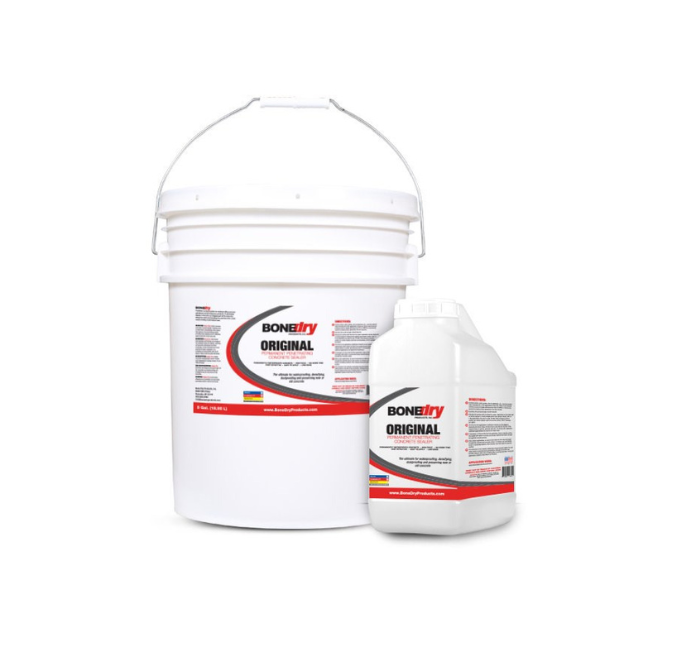
Choosing a sealer means choosing a product that solves the problem at its source. Bone Dry Original and the other Bone Dry penetrating sealers create a waterproof barrier inside the slab, stopping moisture vapor transmission before it reaches the surface. That protection helps prevent mold growth, adhesive failure, dusting, flaking, and flooring damage that can derail projects or disrupt daily life.
What Makes a Penetrating Sealer Last
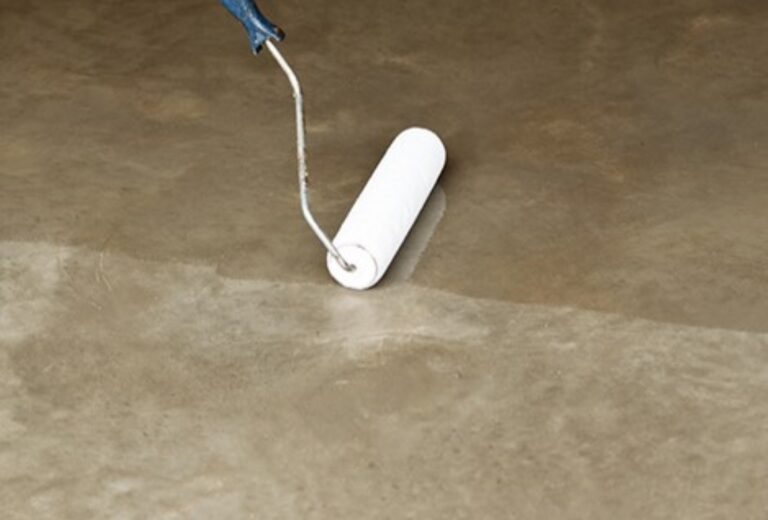
The difference comes down to performance, longevity, and trust. Bone Dry sealers are engineered to penetrate deeply into concrete pores, filling capillaries and becoming a permanent part of the slab. Unlike topical sealers, they do not peel, wear off, or require frequent reapplication. Once applied, the protection lasts for the life of the concrete.
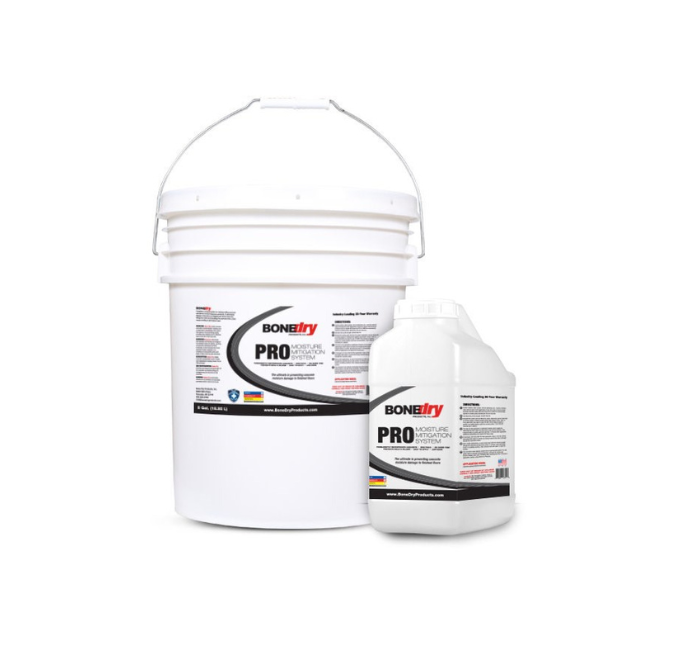
Bone Dry Pro, our flagship commercial solution, can be applied as soon as concrete is hard enough to walk on. This allows sealing and curing to happen at the same time, saving valuable days on construction schedules. For projects where speed, reliability, and long-term results matter, this approach sets Bone Dry apart.
Built for Residential and Commercial Confidence
Homeowners, contractors, architects, and facility managers all face the same concern: moisture failure is expensive. A sealer under flooring must work for both new and existing slabs, indoors and outdoors, and under a wide range of flooring systems. Bone Dry sealers are compatible with adhered, floating, anchored, epoxy, and resinous flooring systems, making them a versatile solution across industries.
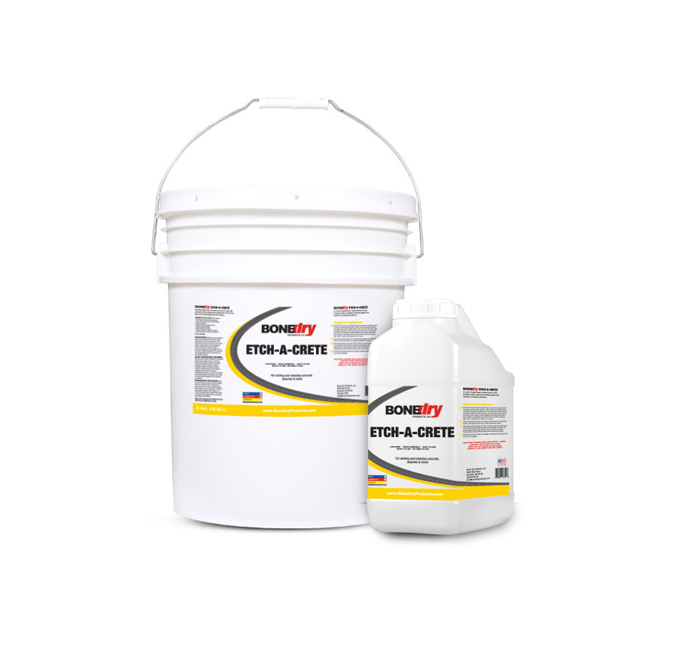
For commercial applications, Bone Dry Pro is sized to the slab, Etch-A-Crete is available separately where an existing surface needs etching, and our in-house crew can apply the sealer or a representative can oversee your contractor. Every order is based on slab condition, square footage, and flooring type, so you receive exactly what your project requires and nothing you don’t.
Based in Kenosha, WI, we can ship nationwide to provide the concrete sealing support you need for any project.
Commercial Protection Backed by a 25-Year Warranty
What defines a commercial sealer is accountability. The Bone Dry Pro System is backed by a 25-year warranty against moisture-related and bonding failures, and Bone Dry Pro Admix carries a lifetime flooring and roofing system replacement warranty. This level of protection reflects confidence built through decades of real-world performance. It also provides peace of mind for anyone responsible for long-term building performance, from business owners to property managers.
If you’re ready to stop moisture problems before they start, reach out today to discuss your project and get a solution built specifically for your concrete.
Penetrating vs. Film-Forming: Which Type of Sealer Is Best for Your Slab?
“Best” depends on where the sealer has to live. A film-forming product protects from the top down and has to be maintained; a penetrating sealer works inside the slab and is done once. The table compares the four sealer types we are asked about most.
| Sealer type | Where it lives | Peels or wears? | Under flooring? | Best for |
|---|---|---|---|---|
| Penetrating sealer (Bone Dry Original, Plus, Pro) | Inside the slab — fills the pores and reacts with free lime; the concrete looks unchanged | No film, so nothing to peel, wear off or recoat; permanent | Yes — adhered, floating and resinous flooring systems and paints go over it | Slabs under flooring, basements, garages; existing slabs (Original, Plus) and new pours (Pro) |
| Acrylic cure-and-seal (film-forming)* | A film on the surface | Wears in traffic lanes and can be slippery when wet; typically stripped and recoated on a schedule | Surface film only — it does not stop vapor from below; check the flooring manufacturer’s requirements before installing over it | Exposed flatwork where a gloss finish is wanted and a recoat cycle is acceptable |
| Epoxy or resinous coating* | A film on top that changes the floor | Multi-step, often professional application with slow cure windows | It is the floor finish, or a moisture-mitigation coat applied after cure, dry-down and RH testing over a shot-blasted profile | Finished resinous floors; moisture mitigation after a slab has already failed an RH test |
| Silane-siloxane water repellent* | Just below the surface, as a breathable water repellent | No film to peel, but the repellency weathers and is reapplied | Not designed as a vapor barrier under flooring | Exterior masonry and flatwork where beading water, not blocking vapor, is the goal |
*Acrylic, epoxy and silane-siloxane rows reflect typical published characteristics of those product categories. Verify against specific products.
For a slab that is getting flooring, the question is vapor: a concrete moisture barrier has to stop moisture inside the concrete, and only a penetrating sealer does that without adding a layer the adhesive has to bond to.
Pick the Bone Dry sealer for your slab
- Standard slab under flooring, garage, most projects: Bone Dry Original — waterproof concrete floor sealer. Garden-sprayer application; 200–250 sq ft per gallon on broom-finished concrete, 300–350 on machine-troweled concrete, 350–450 on burnished or polished slabs opened with Etch-A-Crete; dries in 18–24 hours before flooring, or 6 hours with Quick Dry.
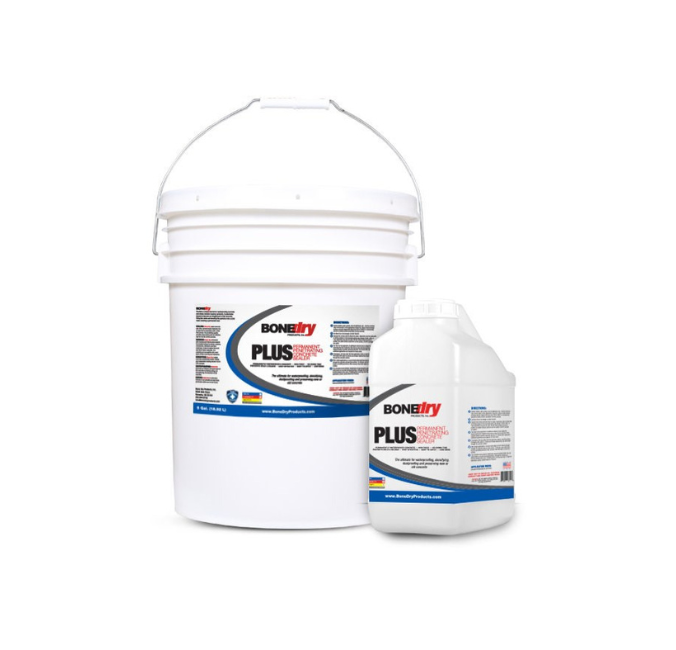
- Mold-prone basement or hygiene-critical facility: Bone Dry Plus — antimicrobial basement concrete sealer. The Original seal with antimicrobial protection built into the pores.
- Large commercial pour, cure and seal in one step: Bone Dry Pro. Sprayed as soon as the slab can be walked on; the Bone Dry Pro System carries a 25-year warranty against moisture-related and bonding failures.
- New pour, waterproofing in the mix: Bone Dry Pro Admix. Dosed at the batch plant; lifetime flooring and roofing system replacement warranty.
- Outdoor driveway, patio or sidewalk: Bone Dry Driveway Sealer. Penetrating, dries clear, no recoat cycle.
Step-by-step guides: sealing a slab on grade before flooring, sealing a below-grade concrete slab, and the Bone Dry product selector.
Bone Dry Original vs Plus vs Pro, from the technical data sheets
The three penetrating sealers share one chemistry; the differences are the antimicrobial additive in Plus and the commercial application, coverage and warranty terms on Pro. The figures below are taken from each product’s technical data sheet.
| Bone Dry Original | Bone Dry Plus | Bone Dry Pro | |
|---|---|---|---|
| Type | Permanent, one-time application; water based; VOC free | Permanent, one-time application; water based; VOC free; added antimicrobial protection | Permanent, VOC-free, spray-applied professional-grade penetrating sealer |
| Where it is used | Interior and exterior; below-, on- and above-grade slabs; new and existing concrete; under or over patching compounds | Interior and exterior; below-, on- and above-grade slabs; new and existing concrete; under or over patching compounds | During the concrete pour, on new or existing slabs, and beneath or atop cementitious toppings; protects finished flooring, adhesives, surface coatings and roofing systems |
| Antimicrobial | — | Built in; prevents the growth of mold, mildew and odor-causing bacteria in the pores of the slab, and keeps working for the life of the product | — |
| Coverage per gallon | 200–250 sq ft on broom-troweled surfaces; 300–350 on mechanically troweled surfaces; 350–450 on heavily burnished or polished slabs where the pores are opened with Etch-a-Crete | 200–250 sq ft on broom-troweled surfaces; 300–350 on mechanically troweled surfaces; 350–450 on heavily burnished or polished slabs where the pores are opened with Etch-a-Crete | 300–340 sq ft on broom-finished, troweled or mechanically profiled surfaces; 350–400 on heavily burnished, polished or Etch-a-Crete-treated surfaces; up to 500 in select cases |
| Dry time before flooring | 18–24 hours before installing finished flooring; 6 hours with the Quick Dry option | 18–24 hours before installing finished flooring; 6 hours with the Quick Dry option | Dries in approximately 6 hours; 12 hours or overnight recommended for full curing |
| Moisture and pH protection | Protects finished flooring, coatings and adhesives on slabs with up to 100% relative humidity (RH) and calcium chloride readings reaching 25 lbs; neutralizes high pH | Protects finished flooring, coatings and adhesives on slabs with up to 100% relative humidity (RH) and calcium chloride readings reaching 25 lbs; neutralizes high pH | Shields finished surfaces and adhesives on slabs with RH up to 100% and MVER up to 25 lbs/1,000 sq ft/24 hours; neutralizes elevated pH; no further moisture testing is necessary after application |
| Standards listed on the data sheet | None listed | Complies with ASTM C156-17, ASTM C39/C39M-18 and ASTM C1202-19 | Cure improvement tested to ASTM C157, C666, C1543, C39, C672 and D7234; finish protection referenced to ASTM D1653-13, E96/E96M-16, F2170-19 and F1869-16a |
| Application | Pump or battery sprayer with a wide fan tip. One coat to a wet or slightly cloudy appearance, then a second coat within 10 minutes only where the first has penetrated. At the pour: one coat at 50% overlap once the surface is hard enough to walk on without indentations; flooring less than 14 days after the pour needs Bone Dry approval | Pump or battery sprayer with a wide fan tip. One coat to a wet or slightly cloudy appearance, then a second coat within 10 minutes only where the first has penetrated. At the pour: one coat at 50% overlap once the surface is hard enough to walk on without indentations; flooring less than 14 days after the pour needs Bone Dry approval | Sprayer, in sections of 1,000–1,500 sq ft. A saturated, lightly opaque first coat, then a second coat after 3–5 minutes only where it has absorbed. At the pour: a single heavy coat at 50% overlap once the slab supports foot traffic without indentation; flooring within 14 days of placement needs Bone Dry approval |
| Application temperature | Ambient and surface temperatures between 35 °F and 95 °F | Ambient and surface temperatures between 35 °F and 95 °F | Ambient and surface temperatures between 35 °F and 95 °F |
| Warranty | Manufacturer’s limited warranty that the product is free of defects; covers only replacing the Bone Dry product | Manufacturer’s limited warranty that the product is free of defects; covers only replacing the Bone Dry product | Project specific 25 year commercial warranty: material and labor to remove and replace the cementitious top coating, adhesive and finished surfaces if there is a concrete moisture, bonding or pH related issue; executed per project after invoicing. Contact Bone Dry Products for details |
| Sizes | 1 gallon and 5 gallon, each with or without Quick Dry — Bone Dry Original | 1 gallon and 5 gallon, each with or without Quick Dry — Bone Dry Plus | Sized to the project — Bone Dry Pro |
Figures from the current Bone Dry technical data sheets (Original, Plus and Pro, all Rev. 10/9/2026). Download the TDS on each product page. A dash means the data sheet does not list that item.
Questions about choosing a sealer
For a basement that smells musty or has had mold or mildew, use Bone Dry Plus, the antimicrobial basement concrete sealer: it is the Original sealer with antimicrobial technology mixed in, which prevents the growth of mold, mildew and odor-causing bacteria in the pores of the slab. For a standard basement slab without a growth problem, Bone Dry Original. Both are rated for below-, on- and above-grade slabs and are sprayed on from inside the room. Step by step: sealing a below-grade concrete slab.
A penetrating sealer applied at the pour. Once the concrete surface is hard enough to walk on without indentations, apply one coat with a 50% overlap; only one coat is required, and curing blankets can go on once the sealer is dry to the touch. Bone Dry Pro is the commercial product for this; Original and Plus are applied the same way on a residential pour. If finished flooring will go down less than 14 days after the pour, contact Bone Dry Products for approval first. See sealing a new concrete pour.
No. Bone Dry Original, Plus and Pro are listed on their data sheets as permanent: the sealer solidifies in the pores below the surface rather than forming a film, so there is nothing to wear through, peel or recoat. Surface products such as acrylic cure-and-seal, epoxy and silane-siloxane water repellents are maintained or reapplied on a schedule — see the comparison table above.
Bone Dry Pro for Commercial Projects
Bone Dry sells highly effective waterproofing sealers for concrete. We offer an alternative to epoxy concrete sealants. The cons to epoxy sealants include:
- High cost
- Strong odor
- Toxicity
- Difficult application
- Long curing time
- Limited color options
Bone Dry Pro sprays on in one easy application and dries in approximately 6 hours; 12 hours or overnight is recommended before flooring. Bone Dry Pro is our commercial-grade moisture mitigation sealer for large-scale commercial projects. Bone Dry Pro includes an added anti-microbial mixture to mitigate mold and mildew growth under concrete coverings. We’ll include a 25-year replacement warranty that includes labor and material to replace the finished flooring system, adhesives, and prep material.
Concrete Protection for ADUs and Residential Applications
Interest in installing an ADU? An ADU, or accessory dwelling unit, is a small living space attached to or located on the same property as a single-family home. ADUs are used as rental units, in-law apartments or guest homes. Common spaces for ADUs include:
- Above a garage
- Within existing room
- As a separate structure
- Converted shed or barn
ADUs often require a flooring installation, typically over concrete. It’s important to seal the concrete first, before laying new flooring to avoid water damage.